
Texas Wills, Trusts, Probate, and Estate Administration
Practice Areas
The firm helps families plan ahead, respond after a death, administer estates, and resolve disputed probate matters under Texas law. Start with the path that best matches the legal problem in front of you.
Probate and Estate Administration
When a death has already occurred or court authority is needed, begin with the probate and administration path.
Probate Overview
If a death has occurred, this is where you determine whether court authority is needed and what probate path fits the estate.
Probate Process Guide
If you need to understand what the probate process will require of you, this page walks through the sequence from filing to early administration.
Estate Administration
Guidance on inventory, creditor issues, property management, deadlines, and carrying out the work of administration.
Executor Guidance
Focused help for personal representatives who need to understand authority, duties, and how to stay organized.
Family Dispute Resolution
Strategy for will contests, fiduciary disputes, heirship questions, and other contested probate matters.
Wills and Planning Foundations
If you are planning ahead, these are the documents that usually deserve attention first.
Wills Overview
If you are planning ahead, this page explains what a will can do, what it cannot do, and how it fits the rest of your plan.
Simple Will Packages
If your planning needs are straightforward, this page shows how a will-centered plan can still be complete, durable, and usable.
Complex Estate Plans
If your estate plan involves a blended family, a business, significant assets, or several moving parts.
Powers of Attorney
Durable, medical, and related authority documents help your family act2 before a crisis turns confusion into delay.
Living Will and Advance Directives
Health-care instructions and related directives can make serious medical decisions clearer for the people who may need to act for you.
Trusts and Legacy Structures
Trust-based planning is often useful when control, protection, staged distribution, or long-term stewardship matters.
Trusts Overview
If your planning may require privacy, continuity, or management beyond a will, this page explains where trust planning begins.
Revocable Living Trusts
If you are considering a living trust, this page explains when added structure during life and after death may justify it.
Irrevocable Trusts
If your planning goals include stronger separation, tax sensitivity, or long-term control, this page explains where irrevocable structures may fit.
Special Needs Trusts
Planning designed to support a beneficiary with disabilities while respecting benefit rules and family priorities.
Charitable Planning
Legacy structures if you want your estate plan to reflect charitable purpose as well as family care.
Protective Planning and Business Continuity
These matters often involve incapacity planning, long-term care concerns, asset protection, or business continuity planning.
Elder Law and Medicaid Planning
Planning for incapacity, long-term care concerns, benefit eligibility, and family decision-making under pressure.
Asset Protection Strategies
Coordinated planning that looks at ownership, trust structures, liability risk, and long-term stewardship.
Business Succession Planning
Continuity planning for closely held companies, family businesses, and owners thinking beyond today.
If your matter arises in San Antonio, Bexar County, or elsewhere in Texas, the controlling questions are usually questions of Texas law, local court practice, and the practical facts of your family or estate.
Free Client Worksheet
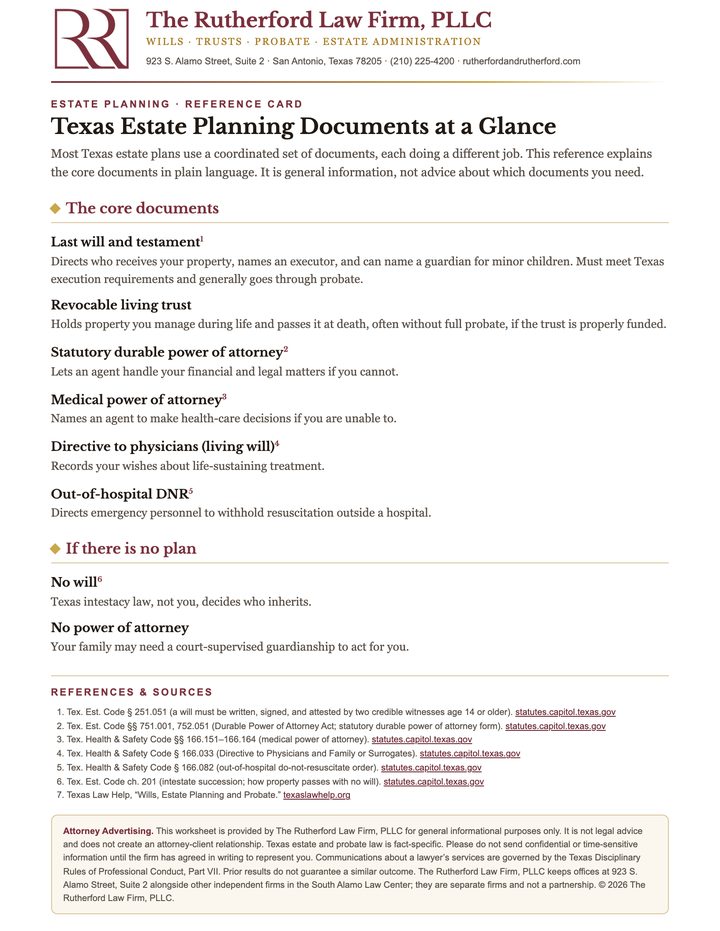
Texas Estate Planning Documents at a Glance
What each core Texas estate-planning document does, in plain language.
Need Help Choosing the Right Starting Point?
If you are not sure which page fits your matter, that is a normal starting point. Estate-planning and probate matters often overlap. A short consultation can usually identify the controlling issue, the documents that matter most, and the next prudent step.
References & Sources
- Tex. Est. Code § 251.051 (a will must be written, signed, and attested by two credible witnesses age 14 or older). statutes.capitol.texas.gov
- Tex. Est. Code §§ 751.001, 752.051 (Durable Power of Attorney Act; statutory durable power of attorney form). statutes.capitol.texas.gov
- Tex. Health & Safety Code §§ 166.151–166.164 (medical power of attorney). statutes.capitol.texas.gov
- Tex. Health & Safety Code § 166.033 (Directive to Physicians and Family or Surrogates). statutes.capitol.texas.gov
- Tex. Health & Safety Code § 166.082 (out-of-hospital do-not-resuscitate order). statutes.capitol.texas.gov
- Tex. Est. Code ch. 201 (intestate succession; how property passes with no will). statutes.capitol.texas.gov
- Texas Law Help, “Wills, Estate Planning and Probate.” texaslawhelp.org
Attorney Advertising. This page is general information, not legal advice, and does not create an attorney-client relationship. Texas estate and probate law is fact-specific; prior results do not guarantee a similar outcome. Communications about a lawyer’s services are governed by the Texas Disciplinary Rules of Professional Conduct, Part VII.