
Official Courts, Clerks, Statutes, and Filing Links
Resources
If your next step depends on a court, clerk, or filing question, this page points you to the official source.
San Antonio and Bexar County At a Glance
Use these links when the local county source is the first thing you need.
Bexar County Probate Courts & Clerk Guide
If you need courthouse, probate division, or clerk contact information, start here.
Bexar County Probate Courts
Official Bexar County probate court listing with current contact information for Probate Courts Nos. 1, 2, and 3.
Bexar County Clerk Services
Official county clerk services page with probate, filing, and courthouse department contact information.
Bexar County Probate Division
Official probate-division landing page for clerk-side probate support and related local information.
Texas Statutes, Forms, and Research
Use these links when the statewide source is the first thing you need.
Texas Probate Forms & Research Guide
Start here for the Estates Code, court forms, e-filing, and vetted research starting points.
Texas Estates Code
The official statutory framework governing Texas probate, wills, estates, powers of attorney, and related procedures.
Texas Judicial Branch Forms
The statewide court forms portal for probate, guardianship, and related judicial forms.
eFileTexas
The official Texas e-filing system used across all 254 counties.
Texas State Law Library Probate Guide
A practical guide for probate books, forms, and deeper Texas study.
Texas State Law Library Wills & Directives Guide
Helpful for wills, directives, and medical-planning research in Texas.
Federal References When Relevant
Use these only when the estate, tax, or benefits question reaches outside Texas court sources.
IRS Estate and Gift Taxes
Useful if your matter involves taxable estate questions, gifting strategy, or higher-value planning.
SSA: What To Do When Someone Dies
Useful if you need survivor-benefit information, death-reporting guidance, or Social Security next steps.
What to Gather Before the First Meeting
A short preparation list helps the first consultation move faster.
- The will, trust, or any older estate-planning documents you can locate.
- A rough list of real estate, accounts, business interests, beneficiary designations, and major debts.
- Any death certificates, court notices, probate paperwork, or letters already received.
- The names of the main family members, fiduciaries, or decision-makers involved.
- Your immediate questions about court procedure, authority, timing, or document updates.
Free Client Worksheet
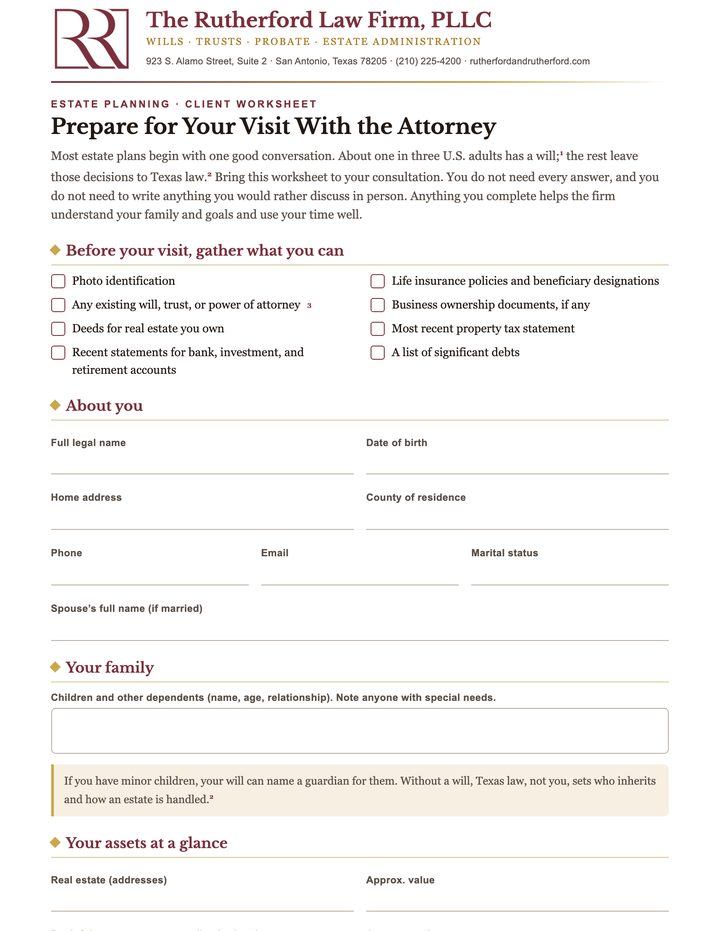
Prepare for Your Visit With the Attorney
A printable worksheet to help you arrive ready: what to bring, your family and assets at a glance, the people you would trust to act for you, and your questions for the attorney. Print it and fill it in by hand, or download the Word version to type your answers.
When You Need Counsel
Frequently Asked Questions
Short answers are here when you want a clear answer before a consultation.
Articles & Insights
These articles give you a closer look at recurring probate and planning issues.
Probate Process Guide
After a death, this page walks through the usual probate sequence in plain language.
Contact the Firm
When the question has moved beyond public information, it is time to talk with counsel about your situation.
County pages, court contacts, and government resources can change. Before you travel or file, confirm the current details on the official linked pages.
When Public Information Is No Longer Enough
When your question moves beyond public information and into legal judgment, the next step is a direct conversation about your family, your estate, and what comes next.
Client Worksheets & Tools
Free, printable worksheets and reference cards to help you prepare. Each opens as a branded PDF you can read here, download, print, email, text, or share. Every worksheet carries the firm’s sources and an attorney-advertising notice.
Prepare for Your Visit With the Attorney
A printable worksheet to help you arrive ready for your estate-planning consultation.
Estate Planning Inventory & Asset Worksheet
Inventory your assets, debts, and beneficiary designations before you meet with the attorney.
What to Bring to a Probate Consultation
Know exactly what to bring so your first probate meeting is clear and productive.
Executor & Administrator First-Steps Checklist
A first-steps checklist for the person named to administer an estate.
When a Loved One Dies: The First Two Weeks
The practical steps families take in the first two weeks after a death.
Document Locator: Where My Documents Are
Tell the people you trust where your documents and key information are kept.
People I Trust: Executor, Agents & Guardians
Name the people who can act for you: executor, financial agent, medical agent, and guardian.
Trust Funding Checklist
Make sure your trust actually controls your property by funding it correctly.
Special Needs Trust Family Worksheet
Gather what the attorney needs to design a special needs trust around your loved one.
Business Succession Planning Worksheet
Plan an orderly transition of your business that coordinates with your estate plan.
Bexar County Probate Quick-Reference
A printable reference to Bexar County’s probate courts, clerk, and filing basics.
Texas Estate Planning Documents at a Glance
What each core Texas estate-planning document does, in plain language.
References & Sources
- Texas Estates Code (official statutes governing wills, probate, and estates). statutes.capitol.texas.gov
- Bexar County Probate Courts. bexar.org/3049/Probate-Courts
- Texas Law Help, “Wills, Estate Planning and Probate.” texaslawhelp.org
- Texas State Law Library, Probate and Wills & Directives research guides. guides.sll.texas.gov
- Pew Research Center, “Experiences With Estate Planning and Discussing End-of-Life Preferences” (Nov. 6, 2025). pewresearch.org
- State Bar of Texas, Texas Disciplinary Rules of Professional Conduct, Part VII (Rules 7.01–7.06). texasbar.com/tdrpc
Attorney Advertising. This page is general information, not legal advice, and does not create an attorney-client relationship. Texas estate and probate law is fact-specific; prior results do not guarantee a similar outcome. Communications about a lawyer’s services are governed by the Texas Disciplinary Rules of Professional Conduct, Part VII.