
A guide to trust-based planning
Trusts Overview
Trusts can serve many different goals. They can help manage assets during life, structure what happens after death, reduce friction around incapacity, and support long-range stewardship for children, families, or charitable interests.

Why clients look at trusts
To coordinate management during life and after death
Some trusts help organize who controls property during incapacity, at death, and through any later administration period.
To create more privacy or continuity
Trust planning may support smoother management and more private administration than a will-only approach for certain families.
To solve more specialized planning goals
Special-needs, charitable, tax-sensitive, or asset-protection goals often involve trust structures rather than wills alone.
Trust planning is often appropriate for
- Clients comparing a will-based plan to a trust-based plan.
- Families with real property, business interests, or multigenerational goals.
- People concerned about incapacity planning, privacy, or administrative continuity.
- Donors and caregivers exploring more specialized trust structures.
How the trust conversation usually unfolds
- Clarify what the client is trying to achieve and what problems the trust is meant to solve.
- Identify which assets, beneficiaries, and decision-makers should be part of the trust structure.
- Choose between revocable, irrevocable, or more specialized options depending on the goals.
- Coordinate the trust with wills, beneficiary designations, powers of attorney, and real-world funding decisions2.
- Review the plan over time to make sure the trust still matches the family and the assets it is meant to serve.
Trust questions clients ask
Does everyone need a trust?
No. Trusts are powerful tools, but they are not automatically the right answer for every household. The goal is fit, not complexity for its own sake.
Can a trust replace a will entirely?
Usually a trust-based plan still coordinates with a will and other documents. Good planning works as a system rather than as one document acting alone.
What makes a trust work well in practice?
Strong drafting, proper funding, thoughtful trustee choices, and coordination with the rest of the client’s estate plan are all essential.
In Texas, the usefulness of a trust depends as much on implementation as on drafting. A beautiful trust that never gets coordinated with the client’s assets rarely delivers the value the family expected.
Related pages
Revocable Living Trusts
Review the most commonly discussed trust tool for flexible family planning.
Irrevocable Trusts
Explore more specialized planning structures with different levels of flexibility.
Special Needs Trusts
See how trust planning can protect a beneficiary with disabilities.
Charitable Planning
Add philanthropy and legacy goals to a broader trust strategy when appropriate.
Free Client Worksheet
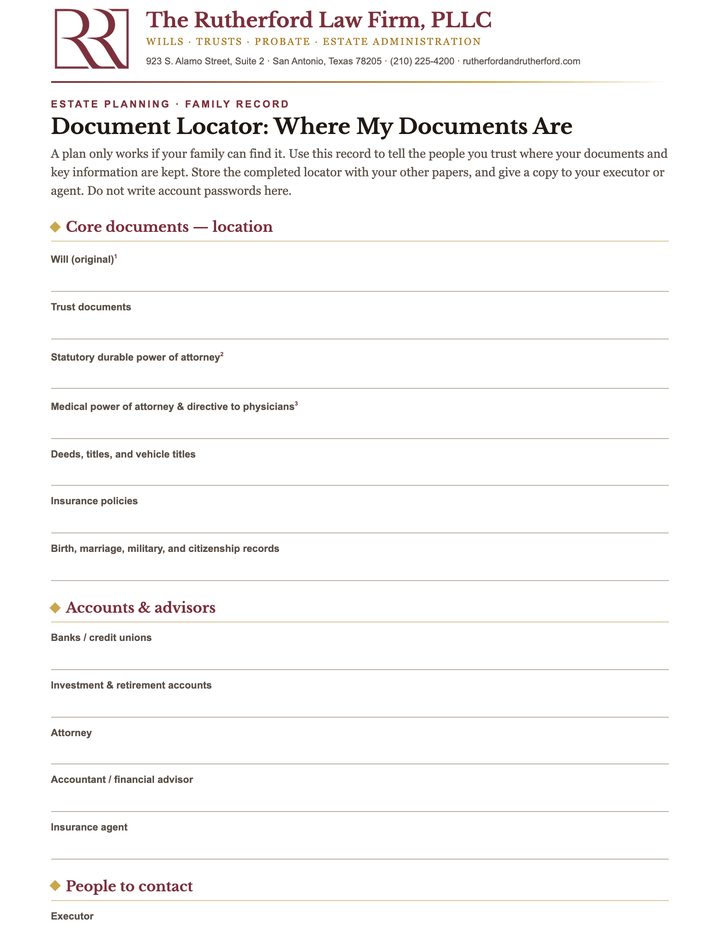
Document Locator: Where My Documents Are
Tell the people you trust where your documents and key information are kept.
The first trust question is usually not which trust, but what the plan needs to accomplish.
The better first question is what you want the plan to accomplish. From there, the firm can help identify whether trust planning truly fits.
References & Sources
- Tex. Est. Code § 251.051 (a will must be written, signed, and attested by two credible witnesses age 14 or older). statutes.capitol.texas.gov
- Tex. Est. Code §§ 751.001, 752.051 (Durable Power of Attorney Act; statutory durable power of attorney form). statutes.capitol.texas.gov
- Tex. Health & Safety Code §§ 166.151–166.164 (medical power of attorney). statutes.capitol.texas.gov
- Texas Law Help, “Wills, Estate Planning and Probate.” texaslawhelp.org
- Texas Disciplinary Rules of Professional Conduct, Part VII (Rules 7.01–7.06). www.texasbar.com
Attorney Advertising. This page is general information, not legal advice, and does not create an attorney-client relationship. Texas estate and probate law is fact-specific; prior results do not guarantee a similar outcome. Communications about a lawyer’s services are governed by the Texas Disciplinary Rules of Professional Conduct, Part VII.