
The foundational document many families start with
Wills Overview
A will remains one of the most important planning tools available to Texas families. It directs who receives property, who should serve in key roles, and how your wishes should be carried out after death.

Why wills matter
They state your wishes clearly
A will creates a direct record of your intentions instead of leaving the family to default rules1 or conflict-driven assumptions.
They help name trusted decision-makers
Executors and related fiduciary roles matter. A will lets you name the people you trust to carry things forward.
They work best inside a coordinated plan
A strong will is often paired with powers of attorney, directives, beneficiary review, and sometimes trusts.
Wills planning is often the right place to start for
- Adults who have no current will and want a starting point.
- Families reviewing older documents that may no longer match their lives.
- Parents, spouses, and business owners thinking about guardianship, control, or succession issues.
- Clients deciding whether a will-only plan is enough or whether a trust-based plan deserves attention.
What a smart will conversation usually covers
- Family structure, relationships, and the people who need to be protected.
- Property, accounts, real estate, business interests, and beneficiary-driven assets.
- Who should serve as executor and whether alternates are needed.
- How the will should coordinate with powers of attorney, directives, and any trust planning.
- When the plan should be reviewed again as life changes.
Common will questions
Does a will avoid probate?
Usually not. A will typically guides what happens through probate4. Other planning tools may help certain assets avoid probate or reduce how much has to pass through it.
How often should a will be updated?
A will should be reviewed after major family, property, health, or business changes, and periodically even when life seems stable.
Is a will enough by itself?
Sometimes yes, sometimes no. That depends on your family, assets, goals, and whether incapacity planning or trust planning should also be part of the structure.
For San Antonio families, the right will is not just about formal validity. It is about practical readability, coordination with Texas law, and making the later probate process easier on the people left behind.
Related pages
Simple Will Packages
Explore will-centered planning for straightforward households.
Complex Estate Plans
See how planning expands when families have more assets, risk, or complexity.
Powers of Attorney
Coordinate your will with the documents that matter during life and incapacity.
Trusts Overview
Compare a will-centered plan with trust-based planning options.
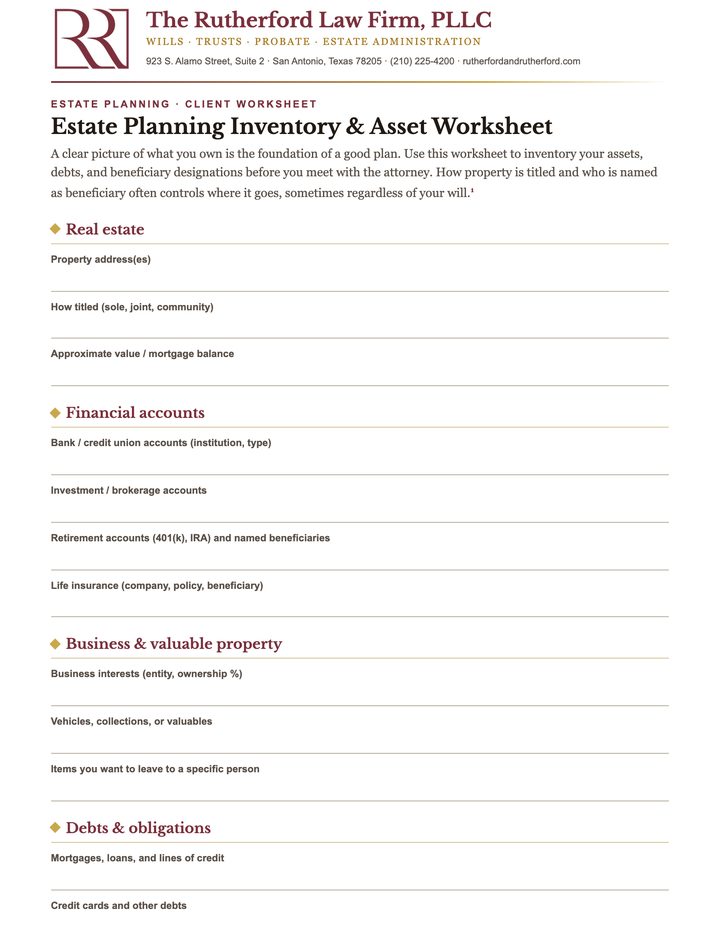
Free Client Worksheet
Estate Planning Inventory & Asset Worksheet
Inventory your assets, debts, and beneficiary designations before you meet with the attorney.
If the current will feels outdated, that is the sign to review it
The firm can help you decide whether you need a straightforward refresh or a more layered estate plan.
References & Sources
- Tex. Est. Code ch. 201 (intestate succession; how property passes with no will). statutes.capitol.texas.gov
- Tex. Est. Code § 251.051 (a will must be written, signed, and attested by two credible witnesses age 14 or older). statutes.capitol.texas.gov
- Internal Revenue Service, Estate and Gift Taxes. www.irs.gov
- Texas Law Help, “Wills, Estate Planning and Probate.” texaslawhelp.org
- Texas Disciplinary Rules of Professional Conduct, Part VII (Rules 7.01–7.06). www.texasbar.com
Attorney Advertising. This page is general information, not legal advice, and does not create an attorney-client relationship. Texas estate and probate law is fact-specific; prior results do not guarantee a similar outcome. Communications about a lawyer’s services are governed by the Texas Disciplinary Rules of Professional Conduct, Part VII.