
Flexible trust planning for life and legacy
Revocable Living Trusts
A revocable living trust is often used when a client wants coordinated management during life, a smoother transition at incapacity or death, and a planning structure that stays flexible while the client remains in control.

Why clients choose revocable trusts
Continuity during incapacity
A revocable trust can help create a clearer management framework if the client becomes unable to act for himself or herself later.
A more organized administration structure
Clients often like the trust format because it can coordinate how assets are managed after death and how successor trustees step in.
Flexibility during life
Because the trust remains revocable during the client’s life, it can usually be amended as family circumstances and goals change.
This page often helps
- Clients considering whether a will-only plan is enough.
- Families with real estate, layered assets, or privacy concerns.
- People who want stronger incapacity coordination inside the estate plan.
- Clients who want structure without giving up lifetime flexibility.
What a revocable trust plan usually requires
- Identify the planning goals the trust is supposed to solve.
- Draft the trust and the coordinating documents around it.
- Choose trustees and successor trustees thoughtfully.
- Coordinate funding and title changes so the trust is more than a paper exercise.
- Review the plan over time as family, property, or management priorities evolve.
Questions about revocable living trusts
Does a revocable trust protect assets from all claims?
Not automatically. Revocable trusts are often chosen for coordination, continuity, and administration goals, not as a blanket shield against every liability concern.
Can the trust be changed later?
Usually yes, while the trust remains revocable and the client has capacity. That flexibility is one of the reasons clients consider this option.
Does the trust still need companion documents?
Yes. A coordinated plan often includes a will, powers of attorney, directives, and other supporting documents2.
A revocable trust only delivers its value if it is coordinated with the client’s actual assets and broader plan. In practice, good funding and follow-through matter just as much as good drafting.
Related pages
Trusts Overview
Return to the broader trust discussion if you are still comparing options.
Irrevocable Trusts
Compare a revocable structure with more locked-in trust planning.
Wills Overview
Understand how trust planning coordinates with a will and other core documents.
Powers of Attorney
Review the authority documents that still matter alongside a trust plan.
Free Client Worksheet
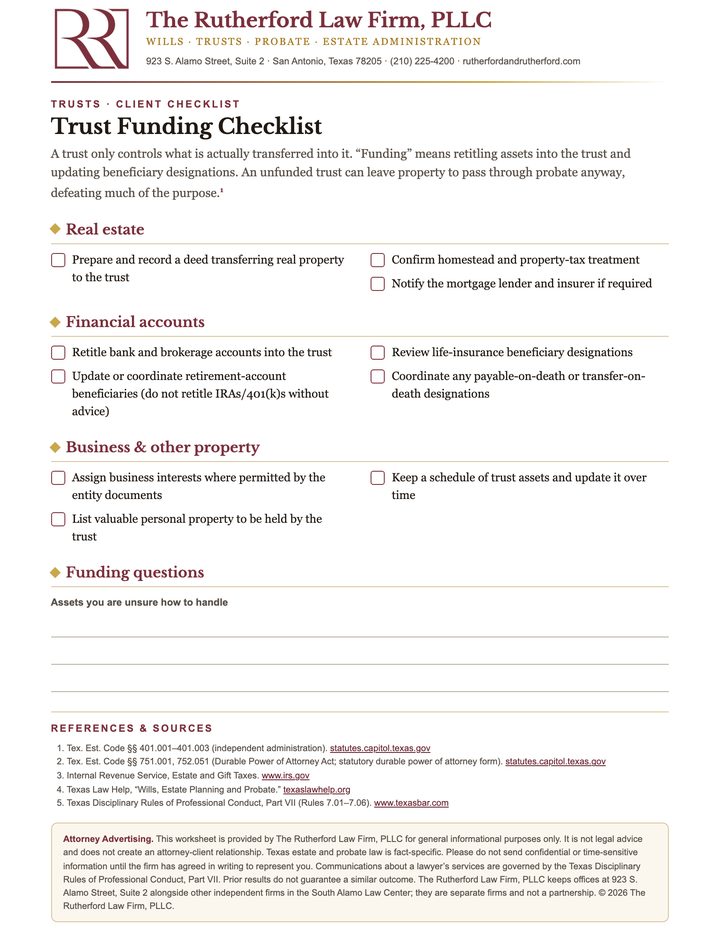
Trust Funding Checklist
Make sure your trust actually controls your property by funding it correctly.
A revocable trust can be elegant, but only if it fits your life
The firm can help you decide whether this kind of trust serves your goals or whether a simpler or more specialized approach fits better.
References & Sources
- Tex. Est. Code §§ 401.001–401.003 (independent administration). statutes.capitol.texas.gov
- Tex. Est. Code §§ 751.001, 752.051 (Durable Power of Attorney Act; statutory durable power of attorney form). statutes.capitol.texas.gov
- Internal Revenue Service, Estate and Gift Taxes. www.irs.gov
- Texas Law Help, “Wills, Estate Planning and Probate.” texaslawhelp.org
- Texas Disciplinary Rules of Professional Conduct, Part VII (Rules 7.01–7.06). www.texasbar.com
Attorney Advertising. This page is general information, not legal advice, and does not create an attorney-client relationship. Texas estate and probate law is fact-specific; prior results do not guarantee a similar outcome. Communications about a lawyer’s services are governed by the Texas Disciplinary Rules of Professional Conduct, Part VII.